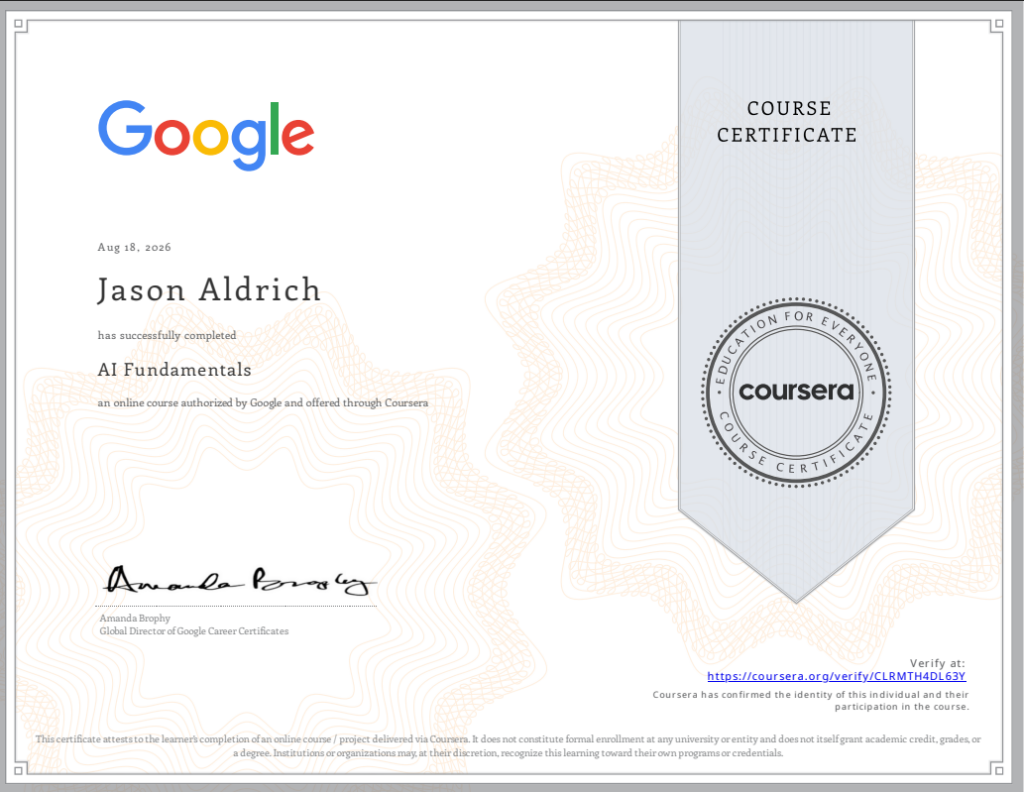
Jason Aldrich recently completed the AI Fundamentals course on Coursera.

Marketing and Real Estate Consultant
Jason Aldrich recently completed the AI Fundamentals course on Coursera.
I started managing standard desktop search ads back when Google AdWords was just a newborn engine in the early 2000s. In those days, we bid on exact keywords, wrote manual text strings, and checked spreadsheets once a week. If you told me then that we’d one day build conversational ad units driven by a multimodal generative engine, I would have laughed you out of the room.
But after reviewing the major announcements from Google Marketing Live 2026, it’s clear: the baseline mechanics of our industry have fundamentally transformed. We are currently living through the most profound evolution in the history of commercial media. For over two decades, digital acquisition relied on a rigid pattern—users typed a highly condensed string into a blank box, and we served a corresponding text chunk. Today, Google’s generative powerhouse, Gemini, has officially taken the steering wheel, completely reshaping user habits and technical execution.
If you plan to protect your competitive advantage and continue scaling your enterprise over the next twelve months, here are the high-priority pillars you need to hard-code into your marketing strategy immediately:
Because users are holding fluid, multi-turn dialogues with the search engine, queries are now significantly more detailed, complex, and intent-rich. In fact, AI Mode queries average 3X the length of traditional search terms.
To capitalize on this, Google is fundamentally reinventing what an ad unit looks like:
Direct Offers: These interactive modules serve tailored incentives to hyper-targeted, high-intent buyers at the exact micro-moment they demonstrate purchase readiness within a live chat context.
Agentic Ads: Powered by Gemini, these ads allow prospects to chat directly with the ad unit itself, automatically capturing and qualifying leads before they ever touch your landing page.
The Playbook Adjustment: Traditional exact-match keyword grouping is no longer sufficient to capture this traffic. Enterprise accounts must shift budgets aggressively into AI Max for Search and Performance Max. These systems are specifically designed to ingest deep semantic data and cleanly align your brand with complex, conversational consumer intents.
Think of UCP as a universal language that allows independent digital agents and merchant engines to sync effortlessly without an ounce of custom engineering. This framework allows real-time operational data—such as immediate local inventory levels, individual customer loyalty benefits, and specific dynamic checkout structures—to flow straight into conversational search results.
Veteran Execution Note: Your underlying assets dictate your AI’s visibility. If your product feeds inside Google Merchant Center are sparse or outdated, your business will become invisible in conversational search results. To stay competitive, you must optimize and enrich your product details—it is the difference between not showing up and being the exact answer.
More importantly for performance buyers, YouTube commands massive, exclusive attention blocks: 45% of YouTube Shorts users do not use TikTok, and 65% are completely absent from Instagram Reels. If you aren’t capturing them here, you aren’t capturing them anywhere.
To monetize this deep user engagement, Google deployed hundreds of updates to Demand Gen campaigns, yielding a substantial 30% average lift in conversions. Furthermore, multi-channel attribution studies demonstrate that adding Demand Gen to an active Search and Performance Max setup boosts Return on Ad Spend (ROAS) by 10% and elevates baseline sales effectiveness by 12%.
When you mathematically aggregate instant performance attribution alongside long-term brand equity, YouTube drives an 86% higher incremental, long-term ROAS than standard paid social platforms. Look well past the standard 30-day window.
Google is eliminating this bottleneck by embedding its core foundational visual models—specifically Gemini and its premier video-generation architecture, Veo—directly into the natively accessible Asset Studio. Marketers can now spin up, rapidly scale, and variations-test professional-grade visual and video components in minutes.
Crucially, this system provides full, frictionless interoperability. Whether you generate product files inside internal structures like Product Studio and Pomelli (Google Labs’ asset tool for SMBs), or pull designs directly from enterprise creative software like Adobe and Canva, everything unifies seamlessly. This allows your brand to deploy high-velocity storytelling across YouTube, Discover, and Search while maintaining strict compliance with corporate brand governance.
A sophisticated data framework requires a multi-layered measurement infrastructure built around three core pillars:
Data Strength: You must maximize your first-party data loops. Ensure all distinct data pipelines are wired through Data Manager and anchored using a robust, compliant Google tag gateway deployment.
Causality Infrastructure: To accurately measure user conversion paths, evaluate near-term purchase intent changes through Attributed Branded Searches (ABS), and calculate long-term performance shifts with Qualified Future Conversions (QFC).
Unified Analytics: Move away from siloed attribution tools. Integrate your data models with Meridian—Google’s open-source, next-generation Marketing Mix Modeling (MMM) engine—which is now completely embedded inside Google Analytics 360 to serve as your central media command center.
The Bottom Line
For those of us who have watched this space evolve since its infancy, the message is clear: success is no longer about manual tweaking or basic keyword matching. The platform has evolved into an interconnected ecosystem driven by smart data, agent-ready asset management, and highly predictive media automation.
The automation engine is fully optimized. The true differentiator now is your operational data quality, your creative velocity, and your strategic direction. Ensure your product feeds are complete, launch your first-party tag infrastructure, and scale your automated campaigns to secure your competitive advantage in this new era.